Nations Students Take Part in Yale Model United Nations Brasil
Nations Takes Part in YMUN, joining hundreds of young delegates in Brasília for three days of debate, diplomacy, and global learning.
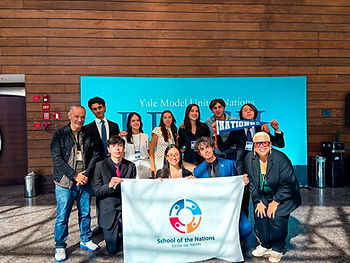
This past weekend, a delegation of nine high school students participated in the first edition of Yale Model United Nations Brasil (YMUNB), held from August 14 to 16 at the Royal Tulip Brasília Alvorada.
Organized as part of the Yale International Relations Association conference series, YMUN Brasil builds on more than 50 years of Yale Model United Nations tradition. The conference brought hundreds of High School students together in Brasília to engage in debate, cultural exchange, and leadership development.
More than 700 students from different Brazilian states took part in the event, creating an environment in which delegates could exchange perspectives, develop new ideas, and experience diplomacy beyond the classroom.
Global issues at the center of debate
Throughout the conference, delegates assumed the roles of diplomats and international representatives, researching complex issues, defending positions, negotiating with peers, and working toward possible solutions to contemporary global challenges.
The conference featured eight General Assembly (GA) and Economic and Social Council (ECOSOC) committees. Their discussions covered a broad range of issues, including artificial intelligence and state surveillance, misinformation and cyber threats, stablecoin governance and financial privacy, Indigenous rights and climate displacement, oil extraction in the Amazon and responsible mining, the impact of automation on workers, transnational drug trafficking, migration and sustainable development, and the role of emerging economies in global trade and investment.
Among the committees were the Disarmament and International Security Committee (DISEC), United Nations Economic and Financial Committee (ECOFIN), United Nations High Commissioner for Refugees (UNHCR), United Nations Environment Assembly (UNEA), International Labour Organization (ILO), Commission on Narcotic Drugs (CND), United Nations Development Programme (UNDP), and United Nations Conference on Trade and Development (UNCTAD).
The scale and diversity of the discussions challenged students to move beyond prepared arguments. Delegates had to listen carefully, respond to different perspectives, communicate their ideas with clarity, and collaborate with others while representing positions that did not necessarily reflect their own views.
Looking beyond the conference
The experience also extended beyond committee sessions. Students had the opportunity to participate in an international university fair, where they connected with representatives from institutions abroad and learned more about higher education opportunities outside Brazil. This added another dimension to the conference, encouraging students to consider future academic pathways while engaging with an international community.
Participating in an event of this magnitude strengthens skills that extend far beyond Model United Nations. Research, public speaking, critical thinking, negotiation, collaboration, and the ability to understand different perspectives are essential not only in academic settings, but also in preparing students to participate thoughtfully in an increasingly interconnected world.
For Nations, providing access to experiences such as YMUN Brasil is also an opportunity to expand learning beyond the school campus. Students return with new perspectives, greater confidence, and firsthand experience of how large international conferences operate.
Their participation can also contribute directly to the continued development of our conference, MUNations. By experiencing different committee formats, procedures, debate strategies, and approaches to delegate engagement, students can bring new ideas and inspiration back to our own conference, strengthening the MUN experience for the wider Nations community.
More than representing the School of the Nations at YMUN Brasil, these nine students became part of a broader exchange of ideas, one that encourages young people to listen, question, collaborate, and see themselves as active participants in the conversations shaping our world.


Comments